
Prices
Costco Price Codes: What .97, .49, .00 and the Asterisk Mean
Costco price codes explained: what .97, .49, .00, .88 and the 'death star' asterisk mean, plus what 1,128 Costcodle game prices show about price endings.
By the Costcodle team · · 9 min read
The endings and marks on a Costco shelf sign work like a secret language, and regular shoppers have learned to read these Costco price codes. The two best-known Costco price secrets: a price ending in .97 usually means a clearance markdown, and an asterisk in the top right corner of the sign means the warehouse is not reordering the item. Costco has never published any of this. Everything below comes from shoppers and employees, and we say how far to trust each claim.
We also bring something most price code guides don’t have: the 1,128 game prices behind Costcodle, our free daily Costco price guessing game. Near the end we show how those prices end, and why the ending of a price can decide a game.
Costco price codes at a glance
Here are the Costco price codes you are likely to hear about, with what each is said to mean and how solid the reports are. Shoppers sometimes call them Costco secret price codes, though the only secret is that Costco never explains them.
| Ending or mark | What shoppers report | How solid | Reported by |
|---|---|---|---|
| .99 | Regular price | Widely reported | The Takeout |
| .97 | Clearance markdown | Widely reported | Reader’s Digest, GOBankingRates |
| .49, .79 (and .89) | Promotion set by the manufacturer | Mixed reports | Yahoo, GOBankingRates |
| .00 and .88 | Manager markdown to clear a few units, sometimes returns | Mixed reports | Reader’s Digest (.00), Yahoo |
| .98 | Same as .99, no markdown | Rarely discussed | The Takeout |
| Asterisk (*) | Not being reordered, the “death star” | Widely reported | SFGate, Yahoo |
The pattern behind the table is simple. A price ending in 9 is the normal state of things. A different ending is the warehouse, the buyer or the brand telling you something changed.
How to read a Costco price tag
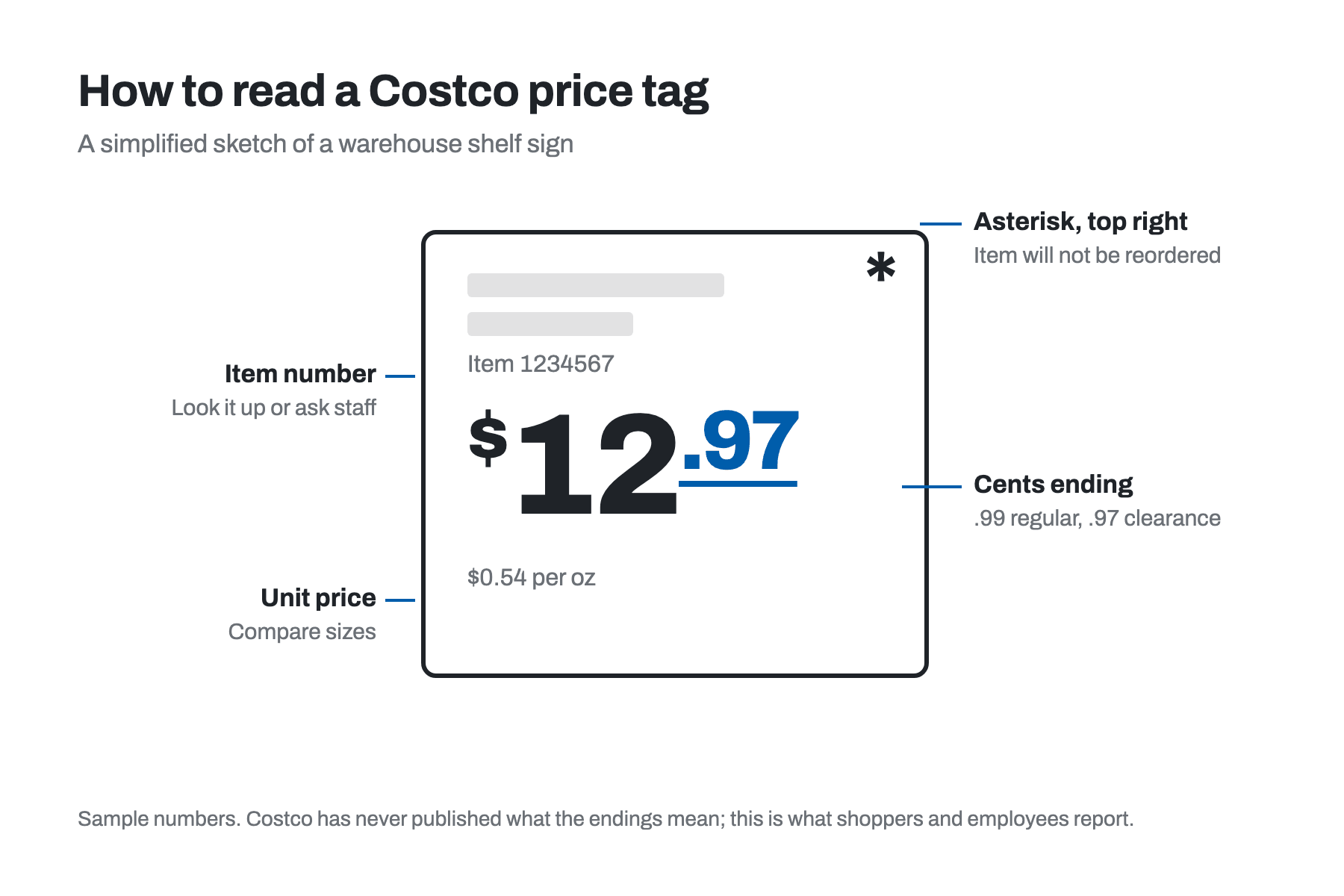
A Costco price tag on a warehouse shelf carries more than the price. Here is what each part of a Costco price tag means:
- The item name. The top lines describe the product and the pack size.
- The cents. The last two digits of the price are where the codes live. A regular price ends in .99; the other endings in the table above are the ones shoppers watch for.
- The top right corner. This is where an asterisk appears when an item is on its way out. SFGate puts it plainly: “If you spot an asterisk in the top right corner of a Costco price tag, take it as a warning to stock up, because that product won’t be replenished.”
- The item number. It identifies the product to staff, which helps if you want to ask about a price, or whether an item with an asterisk is coming back.
- The unit price. Many signs also show a price per ounce or per count. It is the fairest way to compare two sizes, and the quickest Costco price hack for spotting which pack is the better deal.
The sketch above is ours and simplified. Real signs vary by warehouse and by product type, so read it as a map of where to look.
What .97 means at Costco
Of all the endings, .97 at Costco is the one with the most consistent reports. Reader’s Digest quotes a savings expert: “Prices that end in .97 are on clearance and won’t be restocked,” adding that these numbers “typically signify that this is the cheapest price you will ever see on that item.”
Reports differ on who sets the price. A 2023 GOBankingRates piece wrote that “Price tags ending in .97 denote a clearance markdown, according to Business Insider,” while its current version describes .97 as a manager’s markdown that is likely for that one warehouse only. In practice the advice is the same either way: Costco prices ending in .97 are Costco clearance prices for that warehouse, and the same item can still carry its regular price down the road.
If you have been waiting on something and you see it at .97, that is the moment shoppers say to buy. Waiting for a further cut is a gamble, because a clearance item may simply sell out.
The asterisk, or the Costco death star
The asterisk has a nickname. Reader’s Digest notes that it is “known among employees and club members as the ‘Death Star.’” The Costco death star means the warehouse is not reordering the item.
That does not always mean the product is gone for good. In a Reddit thread quoted by Yahoo, a former store employee explained: “the asterisk means the item number is pending deletion in the system. It might just mean that the item is changing packaging/item numbers and will be back again, or it might be gone for the season and come back. It’s not always a ‘gone forever type deal.’” SFGate makes the same point about seasonal goods: once an item is gone, it may be gone “for a while, as with seasonal produce and holiday merchandise, or perhaps for good.”
Put the two codes together and you get the strongest signal on the floor. A .97 price under the Costco death star is an item that has been marked down and will not be restocked in that form. Without the asterisk, a .97 price is a weaker signal: it is still reported as clearance, but the sign does not say the warehouse has stopped ordering it.
.49, .79, .00 and .88
The remaining Costco price codes come with weaker evidence, and the sources do not always agree.
.49 and .79. Yahoo describes these as “a promotional price determined by the item’s manufacturer,” and the 2023 GOBankingRates article said that “products ending in .49, .79, or .89 are generally the subject of manufacturer markdowns.” The idea is that the brand pays for a temporary discount, so the price goes back up when the promotion ends. Nothing about the ending says the item is leaving.
.00 and .88. These are usually described as a manager’s markdown at one warehouse. Reader’s Digest says “Prices that end in .00 are a limited-time managers markdown to get the products moving off the shelf” and that “The .00 price is really local to that store.” Yahoo adds that these endings “can also mean an item was returned.” Here the sources split: Reader’s Digest says a .00 price isn’t necessarily the lowest price, while a shopper quoted by SFGate calls it the lowest price the item will ever be. Treat it as a good price for one item, with no promise beyond that.
.98. You may see .98 described as a markdown code. The evidence points the other way. The Takeout quotes a report that “If a price ends in .98 or .99, ‘That means Costco didn’t get a special deal from the supplier …’” Read it as a regular price.
Whatever a code is said to mean, one rule holds: none of it is official. SFGate credits the spread of the “cracked” code to “social media sleuths and bargain-chasing influencers,” and the reports we found come from U.S. shoppers and U.S. publications; signs in other countries may differ. Use the endings as hints.
What 1,128 Costcodle prices show about price endings
Costcodle is a daily game built on a fixed list of Costco items with a game price for each. Through puzzle #1128 (October 21, 2026), 1,128 puzzles have ended. Here is how their game prices end, and which Costco price codes show up among them.
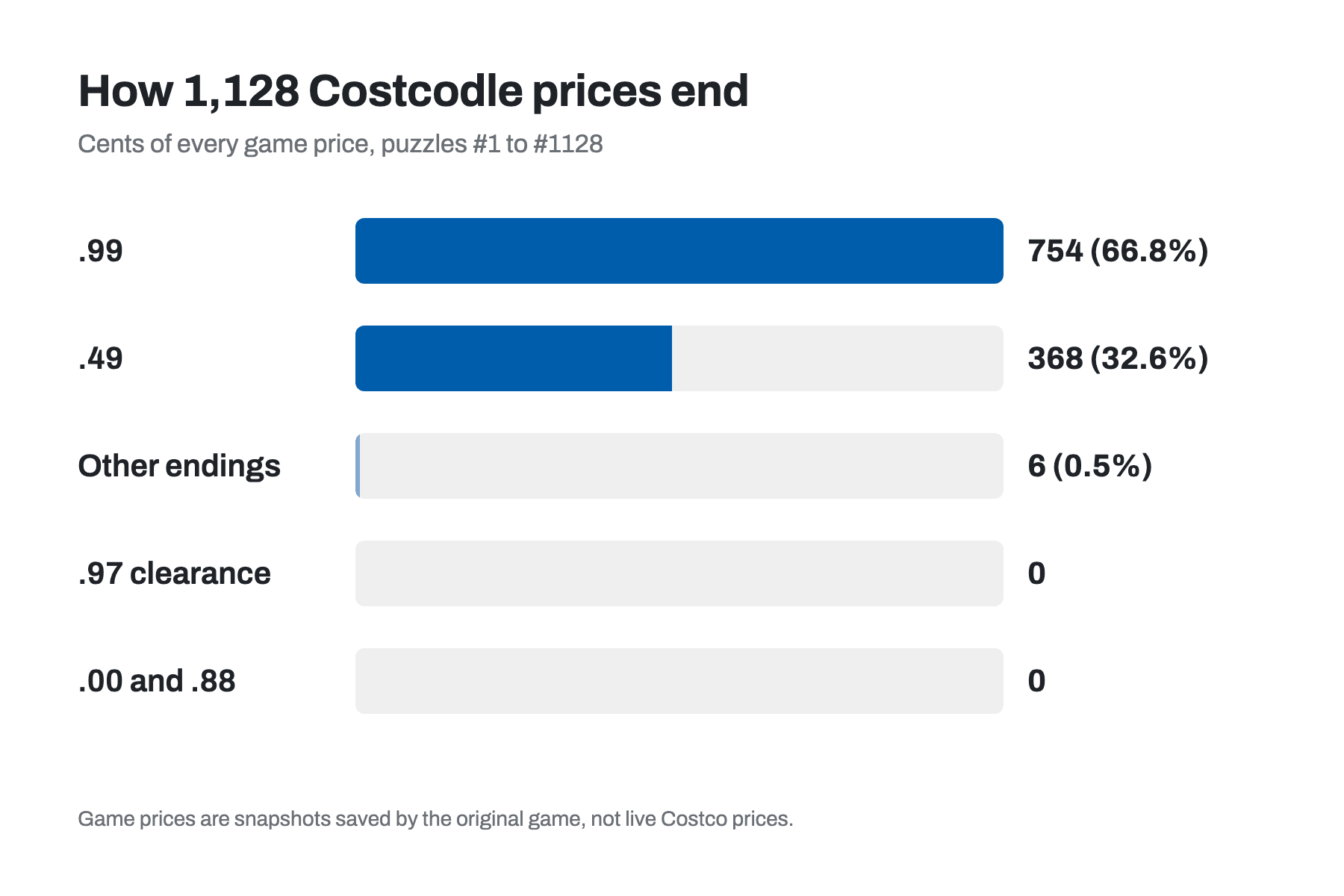
- 754 prices (66.8%) end in .99, the regular-price ending.
- 368 prices (32.6%) end in .49.
- 6 prices (0.5%) end in anything else: $14.92 twice, $15.79, $9.69, $5.59 and $4.69. That $15.79 is the only .79 in the set.
- None end in .97, .00 or .88. There is not a single clearance or manager markdown ending among them.
That last point says something about the data. The game prices are snapshots saved by the original Costcodle game, with no store and no date attached. They look like regular shelf prices, which suits a game: a clearance price would make an odd puzzle. So these numbers describe the game. They can’t tell you whether a given .49 price was a manufacturer deal on the day it was saved, and they say nothing about today’s shelves.
The .49 prices are not spread evenly. They cluster between $10 and $20:
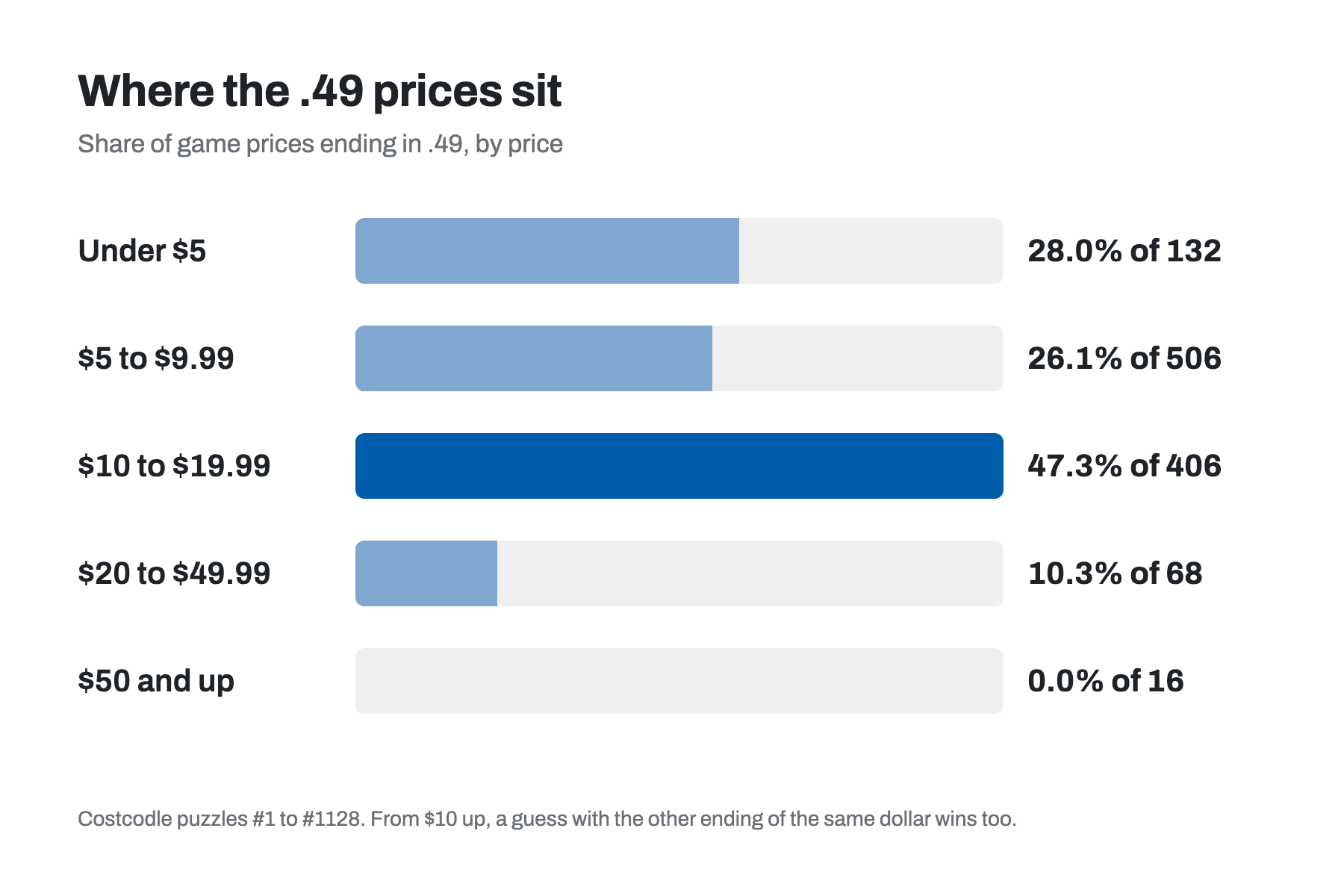
Almost half of the game prices from $10 to $19.99 end in .49 (192 of 406), against about a quarter below $10. Above $20 the .49 ending becomes rare (10.3% from $20 to $49.99), and none of the 16 prices from $50 up use it. Kirkland Signature items lean a little more toward .99: 27.9% of the 165 Kirkland prices end in .49, against 33.4% of the other 963. Every ended puzzle and its price is on the Costcodle answers page.
Use price codes to win Costcodle
In Costcodle, you have six guesses to land within 5% of the game price. Because 99.5% of the prices end in .99 or .49, the cents are really a choice between two endings, and whether that choice matters depends on the price. We checked every price in the set against the game’s own rule:
- From $10 up, the ending never decides the game. For all 487 prices of $10 or more that end in .99 or .49, a guess with the other ending of the same dollar still wins. At $12.49, a guess of $12.99 is 50 cents off, which is inside the 5% window.
- Under $10, the ending always decides it. For all 635 prices under $10 that end in .99 or .49, the other ending misses. Even at $9.99, a guess of $9.49 misses: the winning range starts at $9.50.
So the practical strategy is simple. Above $10, spend your guesses on the dollar amount and type whichever ending you like. Below $10, once you have the dollar, pick the ending on purpose: about three in four of those prices end in .99, so start there. You can practice the habit in Costcodle Unlimited, which deals past items one after another, and check how past puzzles ended on the Costcodle answers page.
Price codes and Costco’s price match policy
Price codes have a practical use after you buy, too. Costco’s customer service page for Costco.com orders says that “purchases that reduce in price within 30 days of the date of purchase are eligible for a price match.” Many shoppers still call this a Costco price adjustment, which is what the page was called until late 2025.
A few details from the same page are worth knowing:
- It covers orders on costco.com. For something you bought in a warehouse, the page says to “inquire at the Returns counter at the Costco location where you made the purchase.”
- It is only about Costco’s own price: “Costco does not price match with other businesses or retailers.”
- Online and warehouse prices are separate, because “Costco.com prices take into account shipping and handling fees not applicable to warehouse purchases.”
So if you bought something in a warehouse and later see it at .97 there, ask at the Returns counter; the page gives no time limit for warehouse purchases, only that you should ask. For a Costco.com order, the 30-day window applies. Costco price codes tell you when a price has dropped; the price match policy is how you might get the difference back.
The short version
Costco price codes come down to two places: the cents and the top right corner. Reading them is one of the easiest Costco hacks: it costs nothing. A .99 is a regular price, .97 is a clearance markdown, .49 and .79 are usually a manufacturer deal, .00 and .88 are a local markdown, and an asterisk means the warehouse is not reordering. All of it is shopper knowledge, so check the price you actually pay at the register.
And if you want to put your price sense to work, there is a new Costco item to guess every day on Costcodle. Costcodle is an independent fan game and is not affiliated with Costco. Its game prices are snapshots, not live store prices.
Costco price codes FAQ
What does .97 mean at Costco?
Shoppers and employees report that a Costco price ending in .97 marks a clearance markdown, often the lowest price that item will reach in that warehouse. Costco has never published its price codes, so read it as a strong hint.
What is the Costco death star?
It is the nickname for the asterisk in the top right corner of a Costco shelf sign. Shoppers read it as a sign that the warehouse is not reordering the item. A former employee says it can also mean a new item number or a seasonal pause.
Does Costco confirm these price codes?
No. Costco has never published what its price endings or the asterisk mean, so every Costco price code meaning you read comes from shoppers, current and former employees, and the articles that collected their accounts.
What does a price ending in .49 mean at Costco?
Prices ending in .49 or .79 are often described as a promotional price set by the manufacturer. In the Costcodle game, about one price in three ends in .49, and almost half of the prices from $10 to $19.99 do.
Do Costcodle prices use Costco price codes?
Not the clearance ones. Of the 1,128 game prices through puzzle #1128, 754 end in .99, 368 end in .49 and none end in .97, .00 or .88. The game prices are snapshots saved by the original game, so they look like regular prices.
Try it on a real price
Costcodle gives you one Costco item a day and six guesses to land within 5% of its price. Unlimited deals past items for as long as you like.