
Strategy
How to Win Costcodle: A Strategy Tested on 1,129 Real Prices
How to win Costcodle: the best first guess, what each hint means and a simple rule that wins 99.3% of 1,129 past puzzles, with a full game on video.
By the Costcodle team · · 8 min read
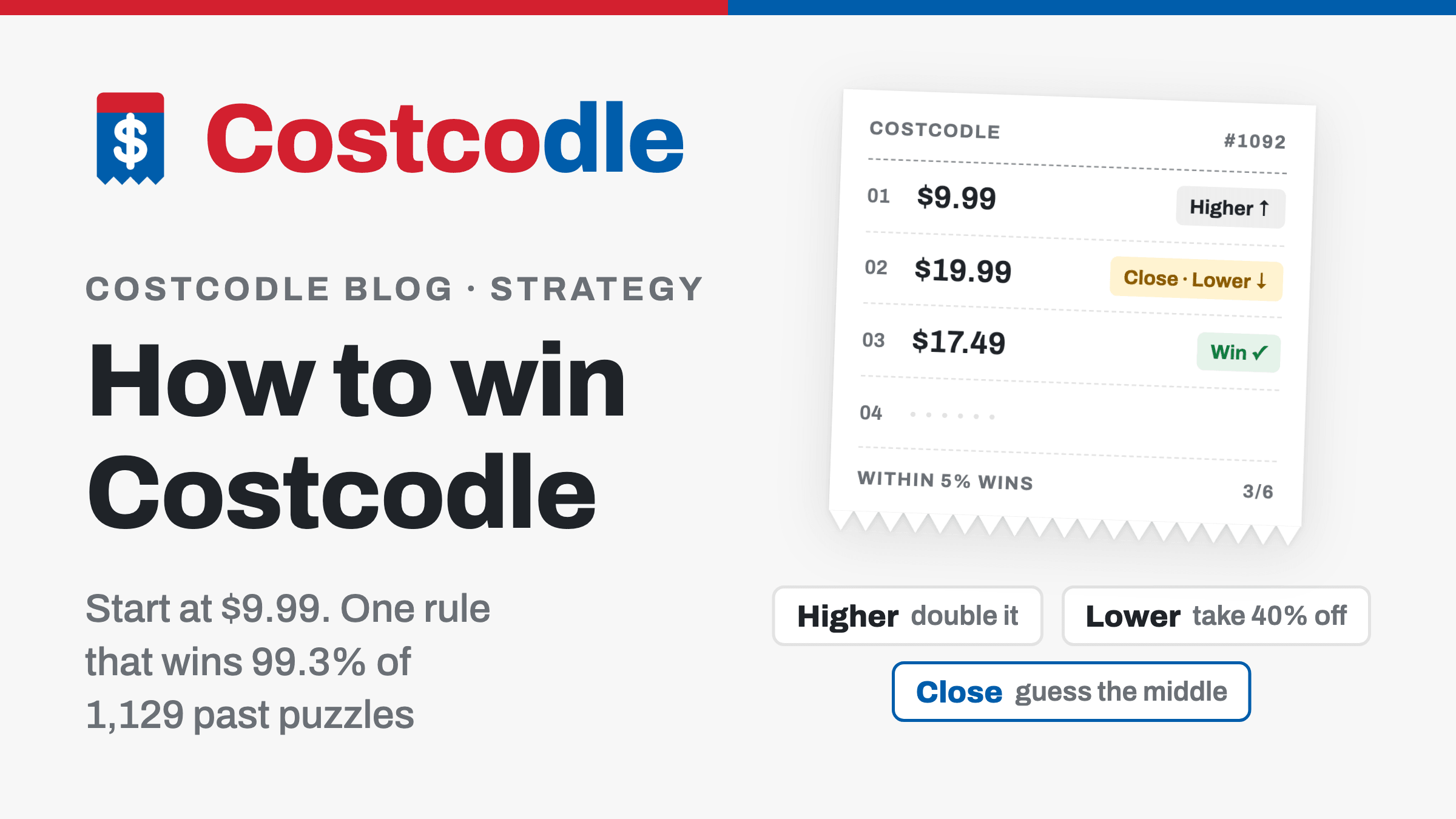
Here is how to win Costcodle in one rule: open with $9.99, double your guess when the hint says Higher, take 40% off when it says Lower, and guess the middle once a Close tag or two opposite hints have boxed the price in. We played that rule against every ended puzzle, #1 to #1129, and it solved 1,121 of 1,129 game prices (99.3%) in 2.93 guesses on average, without looking at a single item.
This guide explains why it works, what each hint tells you, and how to beat the rule by reading the item. You can try it right now on today’s Costcodle, our free daily Costco price guessing game.
How to play Costcodle: the rules in 30 seconds
If you are new, here is how to play Costcodle. Every day there is one Costco item and one game price. You have six guesses. After each guess, the receipt prints a tag:
- Win if your guess is within 5% of the price.
- Close if it is within 25%, with an arrow that says Higher or Lower.
- Higher or Lower alone if you are further off than that.
That is the whole game. The full walkthrough is in the how to play section of the home page. Everything below is about winning in fewer guesses.
What the Costcodle hints really mean
Every Costcodle hint is a statement about the price relative to your guess. Because the windows are percentages, they scale with the price, so it helps to think in multiples of your guess:
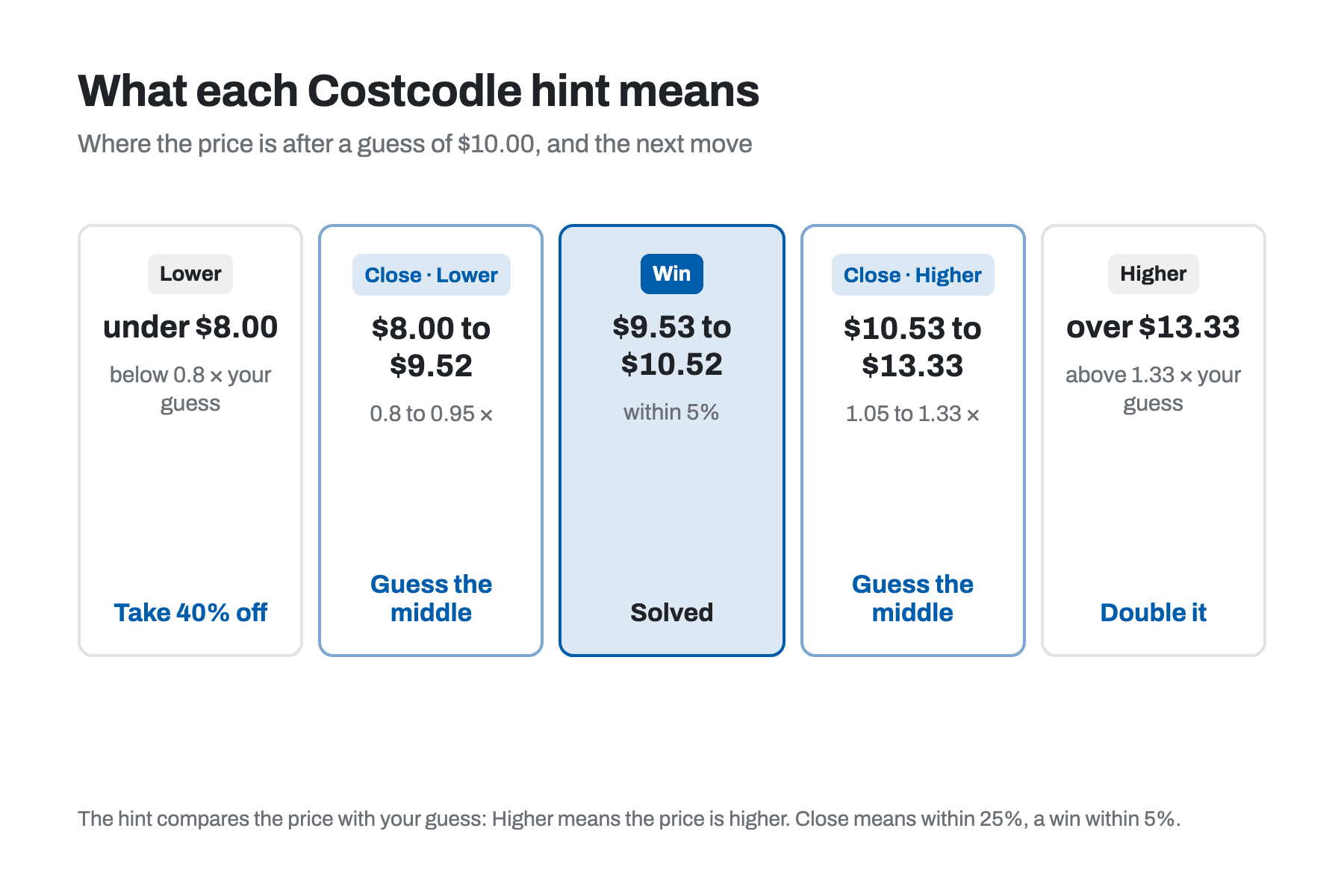
| Tag on your guess | Where the price is | After a $10.00 guess |
|---|---|---|
| Lower | below 0.8 times your guess | under $8.00 |
| Close, Lower | 0.8 to 0.95 times your guess | $8.00 to $9.52 |
| Win | within 5% | $9.53 to $10.52 |
| Close, Higher | 1.05 to 1.33 times your guess | $10.53 to $13.33 |
| Higher | above 1.33 times your guess | over $13.33 |
Two things follow from the table. A plain Higher or Lower only gives you one side of the price, so the next guess has to jump. A Close tag gives you both sides at once, so the next guess can land in the middle of a narrow range. Most Costcodle tips boil down to reacting differently to those two kinds of hints.
The best first guess in Costcodle
With no information yet, the best first guess should sit where the prices are. Here is where all 1,129 game prices fall:
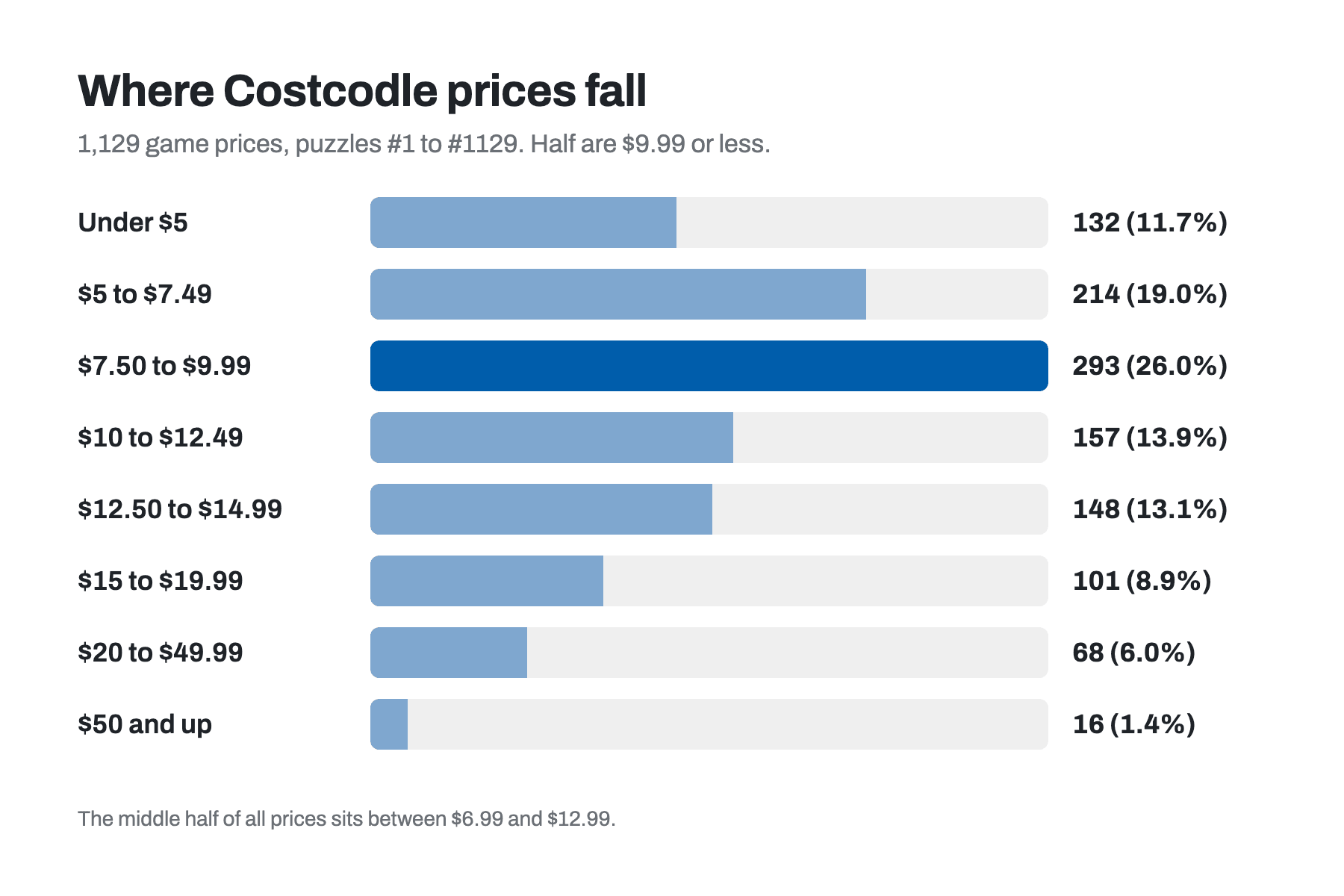
The median is $9.99, and the middle half of all prices sits between $6.99 and $12.99. That makes $9.99 the natural first guess. It won outright on 95 puzzles (8.4%), it was Close on another 323 (28.6%). Counting every arrow, Close or not, the hint said Higher 474 times and Lower 560 times. An even split is what you want from a first guess, because either answer cuts the field roughly in half.
Is there a better opening? If you only care about the first guess, $12.49 wins outright more often than any other price ending in .49 or .99 (128 puzzles, 11.3%). The catch is what happens next: most prices are below it, so it sends you down on most games. Over a whole game, $9.99 came out ahead, which is why the rule uses it.
The $9.99 rule: double it, or take 40% off
Here is the rule in full:
- Guess $9.99.
- Higher with no Close tag: double your last guess. Lower with no Close tag: take 40% off it.
- As soon as you know both a floor and a ceiling (any Close tag, or a Higher and a Lower), guess the middle of what is left.
- End every guess in .49 or .99. Nearly all game prices do, as our guide to Costco price codes shows.
And here is how it did on every ended puzzle:
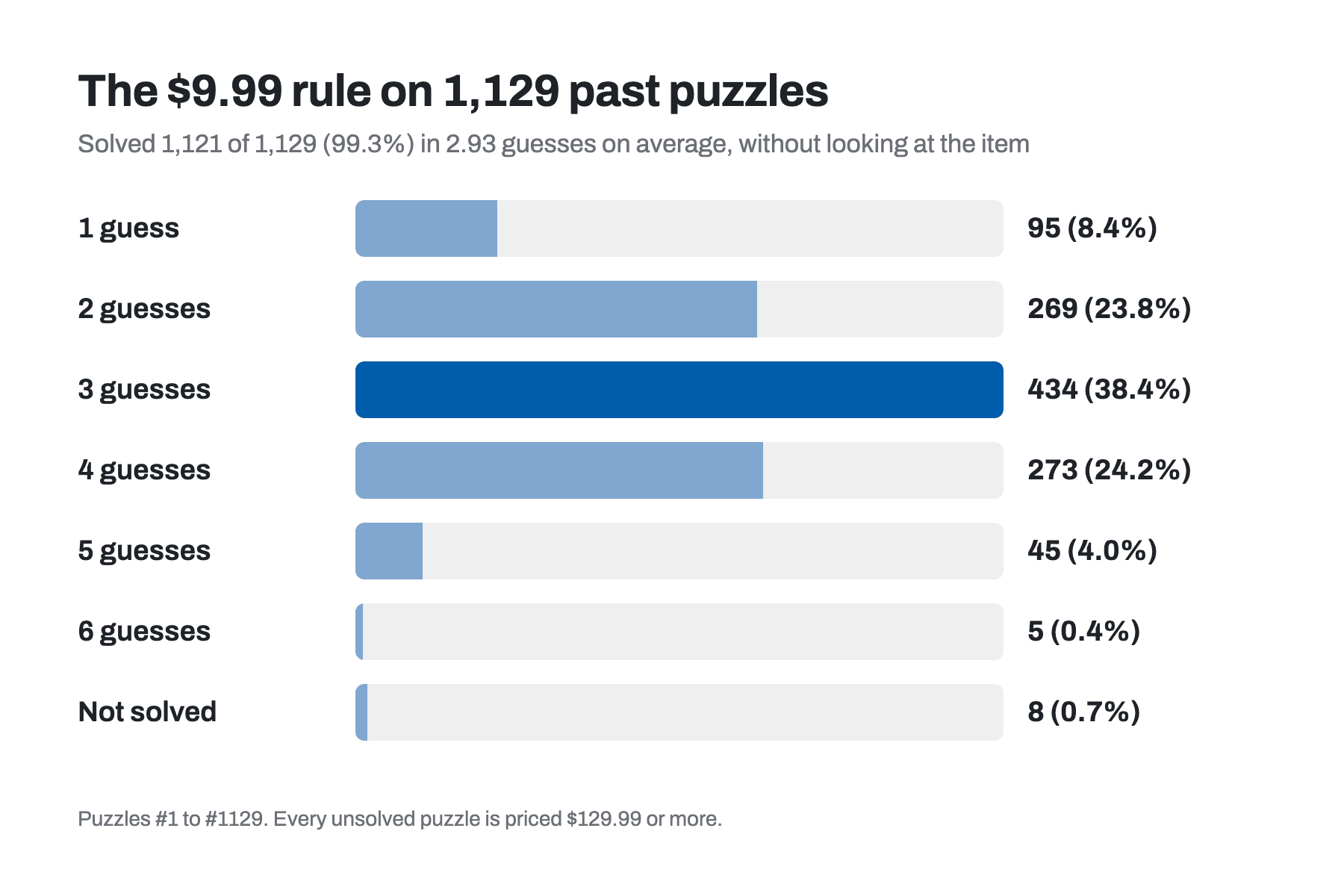
The rule solved 95 puzzles in 1 guess, 269 in 2, 434 in 3, 273 in 4, 45 in 5 and 5 in 6. All 8 games it lost were priced $129.99 or more, which is where doubling from $9.99 runs out of guesses.
A fair question is whether we simply tuned the numbers to fit. We tried to rule that out. We tested 48 combinations of opening guess and multipliers, picked the best one using only puzzles #1 to #800, and then played it on the 329 puzzles after that, which it had never been tuned on. It solved 328 of 329 in 2.88 guesses on average, slightly better than on the puzzles it was picked from. That is the main Costcodle strategy we recommend.
Why doubling works
A plain Higher tells you very little. The price is more than a third above your guess, and that is all: after $9.99 it could be $14 or $140. The fastest way to find out which is to cover ground quickly, and doubling does that. From $9.99, three doublings already reach $79.99, and only 16 game prices are $50 or more. The first Lower or Close you get on the way gives you a ceiling.
Lower works the same way in the other direction, with a smaller step because prices can’t fall below zero and most of them cluster between $5 and $15. Taking 40% off a guess lands well inside the range that a plain Lower leaves open, so you have a good shot at a Close next.
Once you see Close, everything changes. The price now sits in a window between 1.05 and 1.33 times your guess (or 0.8 to 0.95 times, for Close and Lower). That window is narrow enough that guessing its middle either wins or leaves you a much smaller Close range. This is the part of the Costcodle strategy that saves guesses: stop jumping as soon as the game tells you that you are close.
Watch a full game
Here is the rule in action on a real past puzzle in Costcodle Unlimited. The panel on the right shows the price range after every hint.
Video transcript
This is a real past Costcodle puzzle, played with the $9.99 rule. The first guess is always $9.99, the middle of all game prices. Lower, with no Close tag. So the price is under $7.99. There is no floor yet, so take 40% off. That makes $5.99. Close, Higher. Now the price sits between $6.31 and $7.98. Both sides are known, so guess the middle: $6.99. Close, Lower. The range shrinks to $6.31 to $6.65. The middle of that is $6.49. A win in four guesses. The winning range was $6.17 to $6.81. Double it on Higher, take 40% off on Lower, and guess the middle once you have both sides. On 1,129 past puzzles, that rule wins 99.3% of the time.
The game took four guesses: $9.99 got a plain Lower, so the price was under $7.99 and the next guess took 40% off. $5.99 came back Close and Higher, which boxed the price between $6.31 and $7.98. The middle of that, rounded to the nearest .49 or .99 ending, was $6.99, which was Close and Lower. That left $6.31 to $6.65, and $6.49 won.
Common Costcodle mistakes
Knowing how to win Costcodle is partly knowing how players lose guesses. We played the most common habits against the same 1,129 puzzles, so each one comes with a number.
- Creeping after a plain Higher or Lower. It feels safe to raise a guess by a third after Higher, just past the edge the hint gives you, or to cut a fifth after Lower. Played that way, the same opening solved 1,096 puzzles and lost 33, four times as many losses as the rule. Small steps burn guesses when the price is far away.
- Opening high because Costco sells in bulk. Bulk packs feel expensive, but more than half the game prices are $9.99 or less. With the same moves after it, opening at $12.49 took 3.15 guesses on average, and opening at $19.99 took 3.90, almost a full guess more than starting at $9.99.
- Jumping out of a Close range. After a Close, the price is within 25% of your guess. A guess outside that window can’t win, so it only tells you something you already knew. Stay inside the range and split it.
- Ignoring the cents under $10. At $6.49, the winning range runs from $6.17 to $6.81. A guess of $6.99 is Close there, and only the right ending wins. More on that below.
- Forgetting that a guess is information. Each of your six guesses should cut the possible range as much as it can. A guess that you already know is wrong, such as a price below a floor you have seen, is a guess thrown away.
Read the item before you guess
The rule above never looks at the item, and it still wins almost every game. Reading the item can save you a guess or two when you have a feel for the price. A few Costcodle hints from the items themselves:
- Big-ticket items need a different opening. Only 12 of the 1,129 game prices are $100 or more, and the rule lost 8 of them. If the item is a TV, a grill, furniture or anything with a plug and a box the size of a suitcase, skip $9.99 and open in the hundreds.
- Count the pack. Costco sells in bulk, and the name tells you how much: a 24-count, a 2 x 64 oz pack, a 10 lb bag. Estimate one unit, then multiply. A pack of 24 hamburger buns was $3.49 in #1124, cheap per bun, as you would expect at a warehouse.
- Some brands and categories sit higher. Kirkland Signature items had a median game price of $10.99 across 165 puzzles, a dollar above the overall median. Specialty items climb fast: a 17.6 oz jar of manuka honey in #1110 was $30.99, which the rule needed four guesses to reach.
- Trust a confident estimate over $9.99. If the item clearly sits in the $15 to $20 range, open there instead of at $9.99, then switch to the rule for the guesses after it.
Under $10, the cents decide
The 5% window is a share of the price, so it shrinks as prices get smaller. At a price of $20, any guess from $19.00 to $21.00 wins. At a price of $5, the window is only 25 cents each way. Since 639 of the 1,129 game prices (56.6%) are under $10, this matters in most games.
In practice, from $10 up you can win with either .49 or .99 once you have the right dollar. Under $10 you can’t: the ending decides the game, and about three in four of those prices end in .99. Our Costco price codes guide has the full numbers.
Practice with Costcodle Unlimited
The daily game gives you one item a day. To practice the rule faster, play Costcodle Unlimited, which deals past items one after another with the same six guesses and the same tags. It only uses puzzles that have already ended, so it can never spoil today’s game. After a round, you can look up past items and their prices on the Costcodle answers page.
The short version
If you only remember one set of Costcodle tips, make it this one. Open with $9.99. Double on Higher, take 40% off on Lower, and guess the middle once you have both sides. End your guesses in .49 or .99, and read the item to save a guess or two, especially when it is expensive. On 1,129 past puzzles that is enough to win 99.3% of the time, and it is the simplest answer we know to the question of how to win Costcodle.
Ready to try it? Today’s item is waiting on Costcodle. Costcodle is an independent fan game and is not affiliated with Costco. Its game prices are snapshots, not live store prices.
Costcodle tips FAQ
What is the best first guess in Costcodle?
$9.99. It is the median game price, so the price is about as likely to be higher as lower, and it wins outright 8.4% of the time. $12.49 wins outright more often (11.3%), but it leaves you more guesses to make afterwards.
What does Close mean in Costcodle?
Close means your guess is within 25% of the price, but outside the 5% window that wins. The arrow next to it still tells you whether to go higher or lower. After a Close, guess the middle of the range that is left.
Are Costcodle prices in US dollars?
Yes. Every Costcodle price is in US dollars, and you type your guess in dollars and cents. The prices are snapshots saved by the original game, so they can differ from what your warehouse charges today.
Are there Costcodle hints for today's puzzle?
We don't publish hints or answers for today's puzzle, so the daily game stays fair. The strategy on this page works for any item, and once a puzzle has ended its answer appears on the Costcodle answers page.
Can you play past Costcodle puzzles?
Yes. Costcodle Unlimited deals past items one after another, as many as you like, with the same six guesses and the same hints. It only uses puzzles that have already ended, so it never spoils the daily game.
Try it on a real price
Costcodle gives you one Costco item a day and six guesses to land within 5% of its price. Unlimited deals past items for as long as you like.
More from the blog
Prices
Costco Price Codes: What .97, .49, .00 and the Asterisk Mean
Costco price codes explained: what .97, .49, .00, .88 and the 'death star' asterisk mean, plus what 1,128 Costcodle game prices show about price endings.